
German E-Invoicing in 2027: What Freelancers Outside Germany Need to Know
Germany's mandatory B2B e-invoicing applies to domestic businesses, not to freelancers based abroad. But your German clients are converting on a fixed timetable, and their accounts payable process changes with it. Here is what actually affects you, what to put in your invoice template, and what to ignore.
The short answer
If you are a freelancer based outside Germany and you invoice German companies, Germany's mandatory e-invoicing rules do not force you to issue a structured e-invoice. The obligation in the German VAT Act applies to domestic businesses, meaning businesses with their seat, management, or a participating fixed establishment in Germany. A freelancer in Lisbon, Warsaw, or Manchester billing a client in Munich is not covered by it.
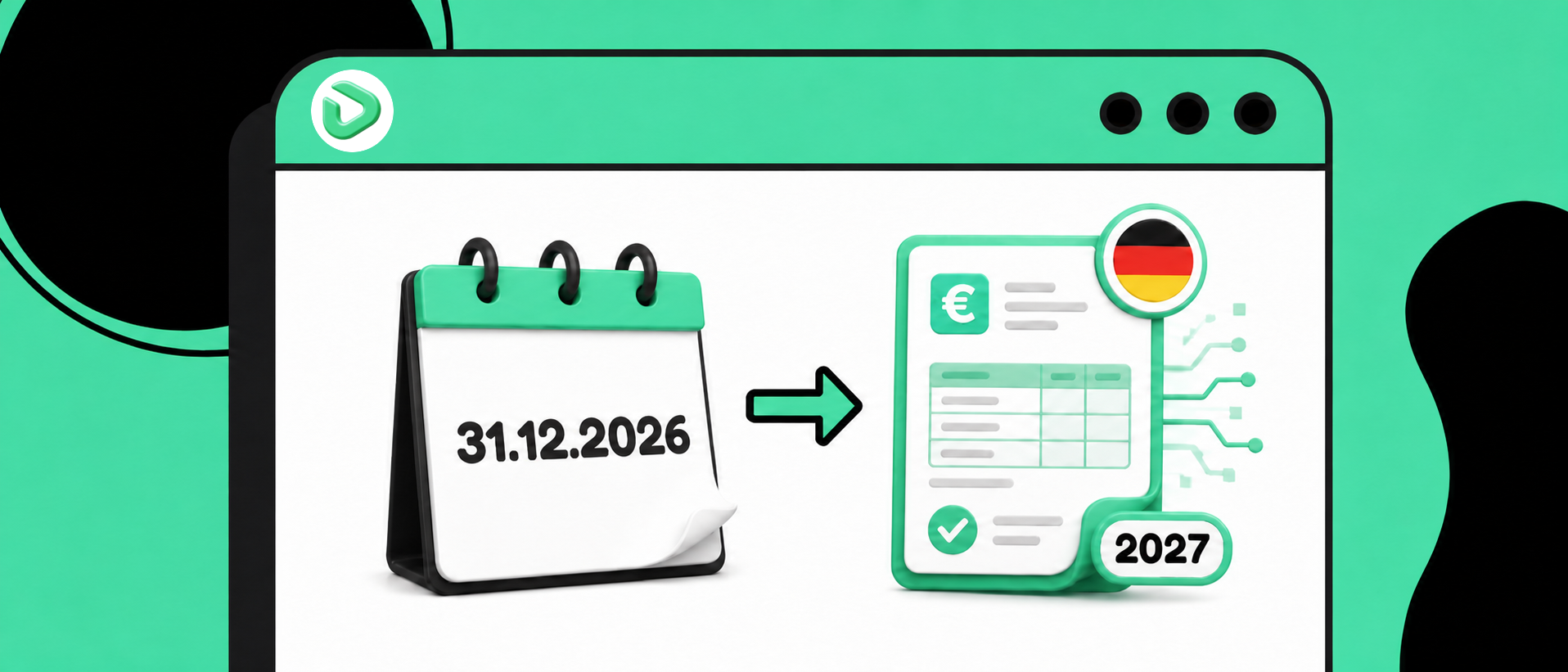
What does change for you is the other side of the transaction. Your German clients are being pulled into structured invoicing on a fixed timetable, and their accounts payable process is changing with it. From January 1, 2027, most of them can no longer send you a plain PDF, and many of them will prefer to receive one back in the same format.
Who is affected, and when
Germany introduced mandatory business-to-business e-invoicing on January 1, 2025. Since that date, an invoice only counts as an e-invoice if it is issued, transmitted, and received in a structured electronic format that allows automated processing. A PDF attached to an email is explicitly not an e-invoice under the new definition. It is a "sonstige Rechnung", an "other invoice", in the same category as paper.
Transitional rules in section 27 (38) of the German VAT Act phase this in:
| Period the service is performed | Who may still send a non-structured invoice |
|---|---|
| Jan 1, 2025 to Dec 31, 2026 | all domestic German businesses |
| Jan 1, 2027 to Dec 31, 2027 | only those with up to €800,000 total turnover in the prior year |
| from Jan 1, 2028 | nobody, apart from statutory exemptions |
The date that matters is when the service was performed, not the invoice date.
For you as a non-German supplier, the practical read is this. Your German clients split into two groups during 2027. Larger ones are already sending and expecting structured invoices. Smaller ones have another year. By 2028, effectively all of them are in.
Where you actually sit in this
The German Federal Ministry of Finance addresses your situation directly. Foreign businesses that are VAT-registered in Germany but have no fixed establishment there can note that fact on the invoice to explain why they are not issuing an e-invoice, and a recipient acting with due commercial care may rely on that statement.
That is a useful sentence to have in your invoice template. It is not a loophole, it is the official position.
Separately, most cross-border B2B services between EU businesses shift the VAT liability to the customer under the reverse charge mechanism, which changes what your invoice has to say. That is a different question from the format question, and it is worth confirming with an accountant for your specific country pair rather than assuming.
What to actually do
- Be able to receive a structured invoice. German suppliers, subcontractors, and tools you buy from will start sending XML. You do not need a platform for this. You need a mailbox that does not silently strip XML attachments, and a viewer.
- Get a viewer. German tax authorities publish a free one at e-rechnung.elster.de that renders both XRechnung and ZUGFeRD files as readable documents. Several free third-party viewers exist too.
- Learn the two formats by sight. XRechnung is pure XML with no visual layer, developed by KoSIT. ZUGFeRD is a hybrid: a PDF you can read with the XML embedded inside it, developed by FeRD. Both satisfy the European standard EN 16931. If a client asks which you support, ZUGFeRD is usually the easier answer because it also looks like an invoice.
- Add the establishment note to your template. One line stating that you have no fixed establishment in Germany saves your client's accounting team a query.
- Ask each German client what they want. Some will accept your PDF indefinitely. Others will ask for ZUGFeRD once their own systems are converted. Asking costs one email and prevents a rejected invoice.
- Consider issuing ZUGFeRD anyway. You are not required to. But an invoice that drops straight into a client's system tends to get approved faster than one somebody has to retype, and that shows up in your payment terms rather than in a tax return.
- Keep the structured file if you receive one. German retention rules require the structured part of an e-invoice to be kept intact in its original form for eight years. Your own country's rules may differ, but keeping the XML rather than only a printout is the safer default in any case.
Common misunderstandings
"Germany is forcing me to change my invoicing." It is not. The obligation is on domestic German businesses. The pressure you feel comes from your clients' processes, not from German tax law reaching across the border.
"A PDF is an electronic invoice." It was until the end of 2024. Under the current definition it is not, because it is not structured. This distinction is the entire point of the reform.
"I can wait until 2028." You can, for issuing. For receiving, your German suppliers may already be sending you XML today, and a file you cannot open is still a file you have to book.
"With ZUGFeRD, the PDF is the authoritative version." That used to be true for hybrid formats. It has been reversed. Where the readable image and the structured data disagree, the structured data now wins. So if you send ZUGFeRD, check the XML, not just how the PDF looks.
"I need a Leitweg-ID." Only for invoices to German public authorities. In ordinary B2B, a placeholder in the BT-10 field is sufficient for VAT purposes.
"A reference to an attachment is enough." For a German e-invoice, all mandatory VAT details have to sit in the structured part. Supporting detail, such as a timesheet breakdown, can travel as an attachment.
What happens if you ignore it
Nothing happens to you from the German tax office, because the obligation is not yours. The consequences are commercial.
A German client whose accounting is fully converted may treat a plain PDF as an exception to be handled manually. Exceptions get queued. Queued invoices get paid late. Some larger clients set a hard requirement in their supplier terms, in which case a non-conforming invoice comes back to you and the payment clock restarts.
The second risk is quieter. If you receive structured invoices from German suppliers and archive only the human-readable rendering, you may have discarded the authoritative version of the document. Whether that matters depends on your own jurisdiction's bookkeeping rules, which is worth a conversation with your accountant before it becomes an audit conversation.
Official sources
- German Federal Ministry of Finance, FAQ on mandatory e-invoicing
- BMF circular of October 15, 2025 on mandatory e-invoicing
- Section 27 UStG, transitional provisions
- Section 14 UStG, issuing invoices
- KoSIT, XRechnung standard
- FeRD, mandatory fields in an e-invoice
- E-invoice viewer provided by the German tax administration
How dVersum helps
dVersum builds invoices that meet German section 14 UStG requirements and exports them as ZUGFeRD files, so a German client's system can read them without anyone retyping a line. Records are stored GoBD-compliant with a DATEV export for accountants, which matters if you work with a German bookkeeper. Time you track on a project converts into an invoice directly. It is hosted in Germany, which also settles the GDPR question that comes up when you compare it with US tools. Starter is €19 per month, or €17 per month billed yearly, with a 7-day free trial and no credit card.
This article is general information as of August 2026 and is not tax advice. Whether and how these rules apply to your situation is a question for a qualified tax adviser in your country.